How to Remove Oil Stains From Driveway
Learn how to remove oil stains from driveway concrete, including why stains form, the best DIY and professional cleaning methods, and when professional treatment delivers the best results.
STAIN REMOVAL
Damon Joao
6/13/20265 min read
How to Remove Oil Stains From Driveway
That dark spot under the car usually starts small, then turns into the one thing you notice every time you pull into the driveway. If you need to remove oil stains from driveway concrete, the right approach depends on how old the stain is, what the surface is made of, and how deep the oil has soaked in.
Fresh drips are much easier to deal with than stains that have been baking in the North County San Diego sun for months. Concrete is porous, which means oil does not just sit on top. It seeps in, bonds with dirt, and creates that stubborn black or brown patch that makes an otherwise clean property look neglected.
The good news is that many oil stains can be improved significantly, and some can be removed almost completely. The less helpful news is that there is no single method that works perfectly every time. A light new stain on standard concrete is different from an old leak on decorative pavers or a heavily worn commercial parking area.
Why oil stains are so hard to remove from driveway surfaces
Oil behaves differently than surface dirt, algae, or dust. Instead of resting on top where a rinse can carry it away, it penetrates the pores of concrete and asphalt. Once that happens, simple hosing usually does very little beyond making the stain look wet.
Time matters. A fresh spill is still close to the surface, so absorbent material and degreasers have a better chance of lifting it. An older stain has had more time to oxidize and settle deeper into the material. Heat also works against you, especially in sunny Southern California conditions where oil can bake into the surface.
The surface itself matters too. Concrete can usually handle more aggressive cleaning than asphalt, which is softer and more vulnerable to damage. Pavers, sealed concrete, and coated surfaces each need a more careful approach.
The best first step to remove oil stains from driveway concrete
If the spill is fresh, start by absorbing as much oil as possible before you add any water. Cat litter, baking soda, cornstarch, or sawdust can all help pull surface oil out. Cover the stain generously and let it sit for several hours, or overnight if possible.
After that, sweep it up and check the area. You may already see a noticeable improvement. If the stain remains, which it often does, move to a cleaning solution rather than reaching for a pressure washer right away.
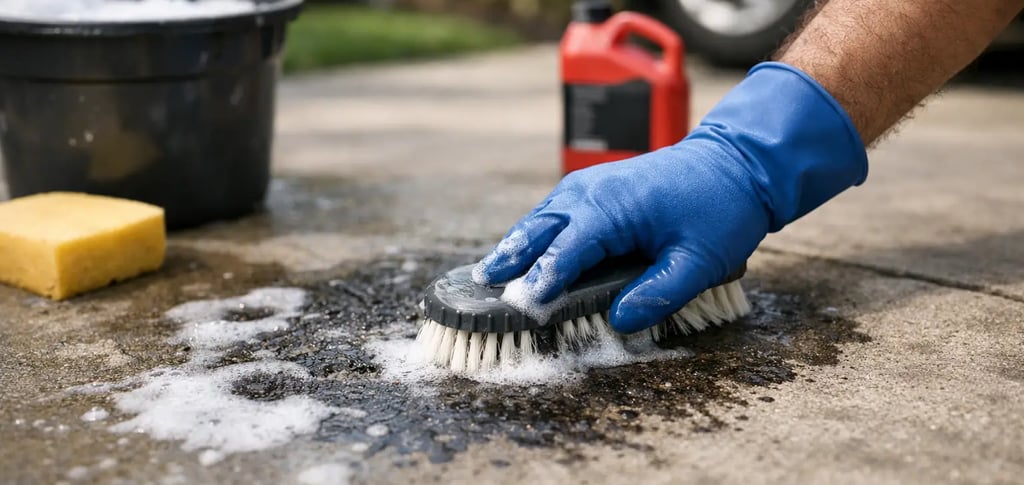
A good degreasing dish soap or concrete-safe degreaser is usually the next step. Apply it directly to the stain, work it in with a stiff bristle brush, and give it time to break down the oil. Dwell time matters. Scrubbing for thirty seconds and rinsing immediately rarely gets strong results.
Warm water can help, but avoid assuming hotter is always better. On some surfaces, especially if you are using a chemical cleaner, you want to follow product directions carefully. The goal is to loosen the oil so it can be lifted out, not just spread around.
DIY methods that work and where they fall short
Homeowners often try a few standard methods first, and that makes sense. For lighter stains, dish soap and scrubbing can be enough. For moderate stains, a dedicated degreaser made for concrete usually performs better because it is designed to break down petroleum residue.
Poultice-style treatments can also help. This means combining an absorbent material with a cleaner to create a paste, then letting it sit over the stain so it draws oil up and out as it dries. This can be effective for deep-set spots, but it takes patience and sometimes more than one application.
There are trade-offs with stronger DIY products. Some harsh chemicals can discolor surrounding concrete, leave residue, or affect nearby landscaping if they are not handled carefully. Others simply do not do much on old stains despite strong claims on the label. If the driveway has a sealant, an overly aggressive cleaner can strip or dull the finish.
Pressure washing is often the tool people want to use first, but pressure alone is not always enough. Oil needs to be chemically broken down, not just blasted with water. In some cases, high pressure can actually push contamination deeper into porous concrete or leave visible clean-and-dirty contrast around the stain.
When pressure washing helps and when it does not
Pressure washing has an important role, but usually as part of the process, not the entire process. Once a degreaser has had time to work, pressure washing can help flush suspended oil and grime from the surface. It can also even out the surrounding concrete so one stained spot does not stand out as much.
That said, results depend on the stain age and the equipment being used. Consumer-grade machines can help with light to moderate staining, but they often do not deliver the surface cleaning power needed for older oil spots. Professional surface cleaning equipment is more effective because it provides more consistent cleaning across a larger area.
There is also a safety and surface-protection side to this. Too much pressure in the wrong hands can etch concrete, damage mortar joints, or leave tiger striping. On asphalt, it can remove material and shorten the life of the surface. The right pressure, nozzle, treatment, and technique matter.
Oil stain removal on concrete vs. asphalt vs. pavers
Concrete is usually the most forgiving surface for oil stain treatment. It is still porous, but it can generally handle degreasing and professional pressure washing better than softer materials.
Asphalt needs more caution. Since it is petroleum-based, aggressive degreasers and high pressure can damage the binder that holds it together. Sometimes the best result on asphalt is improvement rather than full stain removal.
Pavers can be tricky because oil may settle into joints and between units, not just on top. Some pavers also vary in finish or color, which means spot treatment can create uneven appearance if not handled carefully. Sealed surfaces add another layer, because the sealer may be partly worn in one area and intact in another.
This is one reason experienced exterior cleaning matters. The stain is only part of the equation. The surface type determines how far you can safely go.
Signs it is time to call a professional
If you have scrubbed, treated, and rinsed the same spot more than once with little improvement, there is a good chance the stain is set deeper than DIY methods can reach. The same goes for large leaks, multiple vehicle stains, or driveways that have both oil and general discoloration.
Professional cleaning is often the better option when curb appeal matters, especially before guests arrive, a home goes on the market, or a storefront needs to look well-kept. In those cases, it is not just about one spot. It is about restoring a cleaner, more uniform appearance across the whole surface.
A company like Clarity Pro Wash can also evaluate whether the stain is realistically removable or simply reducible. That kind of honest expectation-setting saves time and frustration. Not every stain disappears completely, but the right process can still make a major visual difference.
How to prevent future driveway oil stains
Once you remove oil stains from driveway surfaces, prevention becomes much easier than repeat cleanup. The first step is addressing the source. If a vehicle is leaking, the stain will keep coming back no matter how well the surface is cleaned.
Drip pans or absorbent mats can help if repairs are delayed. For many homeowners, sealing the concrete is also worth considering. A quality sealer does not make the driveway stain-proof, but it gives oil less chance to soak in quickly and makes future cleanup easier.
Routine washing helps too. Dirt and grime combine with oil and make stains look darker and older than they really are. A driveway that is cleaned periodically tends to hold up better visually and is easier to maintain over time.
If you are in San Marcos, Carlsbad, Encinitas, Escondido, Oceanside, Poway, Vista, or nearby areas, this is one of those maintenance items that pays off in a very visible way. A clean driveway changes how the whole front of the property looks.
Oil stains can be stubborn, but they are not always permanent. Start with the least aggressive method that fits the surface, be realistic about older stains, and do not wait too long to treat them. A cleaner driveway usually starts with one simple decision - handle the spot now before it becomes part of the concrete.
Contact Information
Ready to brighten your home’s exterior?
Call
© 2025. All rights reserved.
Whatever you do, work at it with all your heart, as working for the Lord, not for men. -Colossians 3:23